


CSRD Reporting: What It Is and How to Get Started (2026)
Updated September 2026 to reflect the Omnibus I Directive and the new, simplified ESRS.
CSRD reporting is regulated, tightly specified and subject to assurance. The EU's Corporate Sustainability Reporting Directive (CSRD) requires companies to report their environmental, social and governance impacts, risks and targets with the same care as their financial figures.
2026 changed a great deal. Omnibus I narrowed the scope of the CSRD considerably, and the European Commission adopted a lighter set of ESRS. This article covers what CSRD reporting is now, who it applies to, and how to get started step by step.
What is CSRD reporting?
The CSRD is an EU directive that requires the largest companies to report their sustainability impacts, risks, opportunities and targets in a consistent format. The aim is to make sustainability information transparent and comparable across the EU.
Reports follow the European Sustainability Reporting Standards (ESRS), which define what is reported and how. The report forms part of the management report and is subject to assurance.
Who does the CSRD apply to, and when? The position in autumn 2026
The Omnibus I Directive was published in the Official Journal of the EU on 26 February 2026 and entered into force on 18 March 2026. Member States must transpose the changes into national law by 19 March 2027. In short:
- New scope. The CSRD applies to an EU company or group with more than 1,000 employees and more than €450 million in net turnover. Both thresholds must be exceeded in two consecutive financial years. Previously it was two of three: 250 employees, €50M turnover or a €25M balance sheet.
- First-wave companies have reported since financial year 2024. If a company exceeds the new thresholds, reporting continues. If it falls below them, its Member State may exempt it for financial years 2025 and 2026.
- Other large companies that exceed the new thresholds prepare their first report for financial year 2027, published in 2028.
- Listed SMEs are no longer subject to mandatory reporting.
- Non-EU groups report if their EU turnover exceeds €450M and they have an EU subsidiary or branch with more than €200M in turnover. Reporting starts from financial year 2028.
Finland has already implemented the changes. Parliament approved the amendments to the Accounting Act and the Auditing Act (HE 38/2026) on 3 June 2026, and they entered into force on 30 June 2026. The new thresholds apply to financial years beginning on or after 1 July 2026, and a company may choose to apply them to a financial year that began on or after 1 January 2026. A company that reported before but falls below the new thresholds is no longer required to prepare a sustainability statement.
Far fewer companies now have to report, but demand for sustainability data has not dropped. Customers, lenders and the procurement teams of large groups still ask for it. Omnibus puts a ceiling on those requests: a company with fewer than 1,000 employees can decline to provide information beyond the voluntary standard. In practice that standard is VSME, the SME standard, which makes it the shared language of the value chain.
If your company is outside the CSRD's scope, we recommend starting with VSME reporting. It is a light framework built for SMEs. Once the data is collected in a structured way, moving to CSRD reporting later is straightforward. See also the VSME survival guide.
The new ESRS: what changed?
The Commission adopted the simplified standards (ESRS 2026) on 3 July 2026, and they were published in the Official Journal of the EU on 21 September 2026 as Delegated Regulation (EU) 2026/1563. Alongside them came a voluntary reporting standard based on VSME, Delegated Regulation (EU) 2026/1560, which sets the benchmark for the value-chain cap. The main changes:
- Over 60% fewer mandatory datapoints, with more weight on quantitative data than on narrative.
- A top-down double materiality assessment is allowed. For the value chain, information available without undue cost or effort is enough.
- Assurance stays at limited assurance. The move towards reasonable assurance was dropped.
- No mandatory sector-specific standards. The Commission may publish voluntary guidance instead.
All topical standards (E1–E5, S1–S4 and G1) remain, in lighter form. ESRS 2026 enters into force on 10 November 2026 and is mandatory for financial years beginning on or after 1 January 2027. For financial year 2026, a company may use the old standards, the old standards with the new reliefs, or the new standards in full.
The rules have changed several times in two years, so memorising individual requirements is not a good use of time. Planmark keeps the current requirements up to date and uses AI to show what your report is still missing against them, and where the missing information can be found.
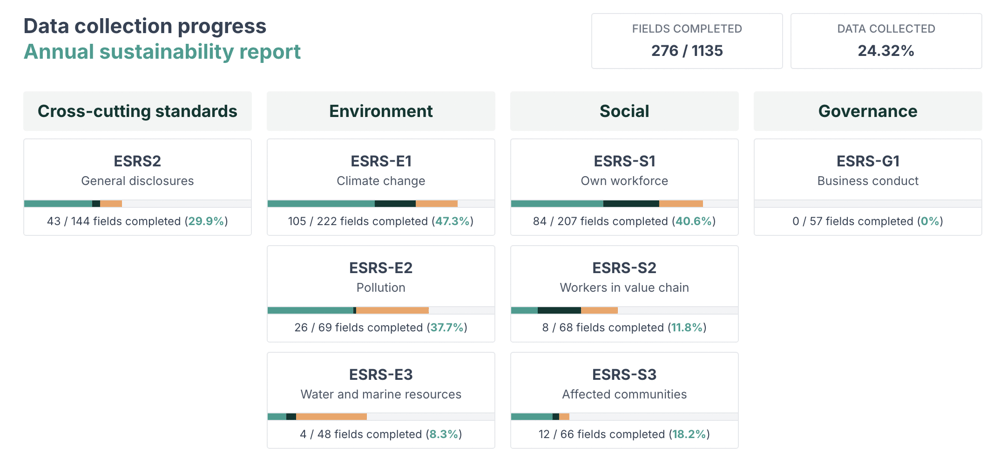
What goes into a CSRD report?
- Environment (E): energy use, greenhouse gas emissions, circular economy, water and biodiversity.
- Social (S): own workforce, workers in the value chain, affected communities and consumers.
- Governance (G): business conduct, anti-corruption and supplier relationships.
- Double materiality: how your company affects the environment and society, and how sustainability matters affect its business. The assessment decides which topics go into the report. Read more: Three double materiality mistakes.
Steps in CSRD reporting: how to get started
1. Check whether the CSRD applies to you
Test your group-level figures against the new thresholds: more than 1,000 employees and more than €450M turnover. At the same time, find out what your customers and lenders are asking for, even if you have no obligation.
2. Map what you already have
Is there a sustainability strategy or policy? Who are your stakeholders? Who owns what? Most companies have more of the groundwork than they think, but it is scattered.
3. Run a double materiality assessment and a gap analysis
Identify your material topics and compare the information you have with what the ESRS require for them. The new standards allow a lighter, top-down assessment, but the reasoning still has to be documented.
4. Define processes and ownership
Who collects each piece of data, which system does it come from, and who checks it? An assurance provider will ask for the source, method and approver of every figure, so record them from the start. More on this: A carbon calculator is not a reporting process.
5. Choose your tool
A spreadsheet works for the first round, but not once ten people in different countries are entering data and every figure's origin must be traceable (template or reporting software?). In Planmark you can upload your existing documentation and Excel reports, and the system maps the information to the right datapoints, so earlier work does not have to be redone.
Setup typically takes a few days. The onboarding demo lasts 30–45 minutes, after which you upload your material and invite users into their roles. See the CSRD reporting software.
6. Compile, assure and publish
Each contributor completes their own section, and the dashboard shows progress in real time. The report is compiled to the ESRS and ready for assurance. The same data can also produce a VSME report or a custom report for a customer, in any language.
7. Monitor and improve
CSRD reporting is not a one-off project but an annual process. Once the structure is in place, next year is an update rather than a fresh start.
Frequently asked questions
What is the CSRD?
The EU's sustainability reporting directive. After Omnibus I, it requires companies with more than 1,000 employees and more than €450M turnover to report on sustainability in a consistent format.
What is the ESRS?
The European Sustainability Reporting Standards: the standards a CSRD report is prepared under. The simplified ESRS 2026 are mandatory from financial year 2027.
Does the CSRD still apply to SMEs?
Not as a legal obligation. Listed SMEs were removed from scope. SMEs still receive data requests from their customers, and these are usually answered using the VSME standard.
What does double materiality mean?
A company assesses both its own impact on the environment and people, and the financial effect of sustainability matters on its business.
Can I prepare a CSRD report in Excel?
You can, but there are hundreds of datapoints, and the report is often put together by 5–10 people across the organisation. Software makes sure every item is covered and that the origin of every figure can be traced. Our customers report that the time spent on reporting has fallen by up to 90%.
How much does CSRD reporting software cost?
Planmark starts at €199/month, and the first 30 days are free. The final price depends on the size of the company and its needs. See pricing.
Is CSRD the same as ESG?
Not quite. ESG is a broad sustainability framework; the CSRD is a specific EU law that sets what must be reported and how. Planmark is built to manage all ESG data in one place: ESG data management.
CSRD reporting software: Planmark
- A clear status view: see in real time what is done and what is missing.
- AI-assisted answers to ESRS datapoints. The AI does not write the report for you, but it takes a lot of the work out of it.
- Data mapping: existing documentation is placed on the right datapoints automatically.
- Traceability: change history, user management and approvals for every data point.
- Reports from the same data: CSRD, VSME or a custom customer report in any language.
- Sustainability agent: answers questions about your company's sustainability based on the data in the system.
Customer example: Kiilto
“Planmark’s CSRD reporting tool was seen as a well-sized and flexible solution that fitted alongside Kiilto’s other software and the needs of the people doing the reporting. Being able to influence the software’s development was important to Kiilto, and working with Planmark on development needs has gone well from the start. The software proved easy to use, letting the CSRD reporting team focus on the content being reported.”
— Laura, Kiilto (Kiilto sustainability report). Translated from Finnish.
How to get started
- Book a demo or start a free 30-day trial.
- See how your current Excel report and documentation are brought into the system, and get a recommendation on the right approach.
- Invite the people you need.
- See straight away what your report is still missing.
The demo takes about 30 minutes. Afterwards you will know what the CSRD requires of your company and where to start.

