
How AI Cuts Hundreds of Hours from Your Sustainability Data Collection
Mastering ESG: Turn Regulatory Pressure into a Competitive Edge
For European manufacturing groups, the “sustainability workload” has become a silent productivity killer. As of February 2026, despite the regulatory breathing room provided by the “Stop-the-Clock” directive, sustainability teams are still drowning in administrative tasks. They spend 80% of their time chasing data across fragmented ERPs, email chains, and spreadsheets, leaving only 20% for actual strategy.
The math is factual: a single manufacturing group with 15 sites and 500 suppliers generates thousands of data points annually. Handling this manually is not just inefficient; it is a disadvantage.
This report explains how Planmark’s AI infrastructure reverses this ratio. Planmark’s automated ingestion and validation engine reduces manual data processing by 70%, ensuring your experts spend their time on strategic decarbonisation pathways backed by audit-ready insights.
1. Where Do the Hours Go?
Before we can optimize your workflow, we must identify the “leaks.” For the modern Sustainability Director, time is disproportionately consumed by four high-friction areas:
Fragmented Data
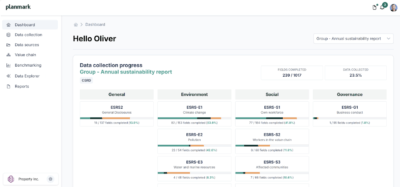
The primary bottleneck is the collection phase itself. Currently, Sustainability Directors are forced into the role of a “data chaser”—manually hunting for information across different business units, siloed ERPs, and endless email chains. Without a centralized way to delegate tasks, the process becomes a game of manual persuasion rather than a streamlined workflow.
Manual Validation & Error Correction
Sustainability leads often default to being “data scrubbers.” Significant hours are lost to identifying unit discrepancies (e.g., kWh vs. MWh), flagging outliers, and fixing formatting errors. Without automated validation, this process remains high-risk, leaving firms vulnerable during third-party audits.
Regulatory Mapping & Alignment
A massive portion of the quarterly workload is spent interpreting complex frameworks. Mapping raw data points to specific disclosure requirements—such as CSRD, VSME, or GRI—requires constant cross-referencing with evolving legal texts to ensure every metric is tagged correctly for machine-readability and compliance.
Ad-hoc Reporting & Investor Q&A
Directors are frequently sidelined by reactive requests. Responding to ad-hoc inquiries from investors, board members, and regulators often requires “archaeological” digs through old files. Manually compiling evidence for audit trails or drafting 100-page narratives consumes hundreds of hours that should be spent on sustainability strategy.
2. How Planmark AI Automates the Grunt Work
Planmark transforms ESG reporting by automating the complex logic and analysis that usually slows a team down. It doesn’t replace your data; it makes your data work for you.
Intelligent Setup and Workflow Creation
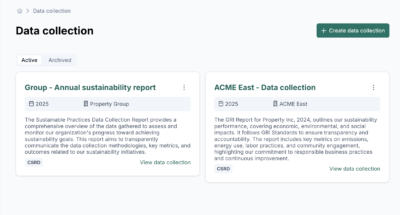
The “regulatory guesswork” of mapping frameworks like CSRD or VSME often leads to teams over-collecting irrelevant data. Planmark replaces this manual interpretation by identifying the exact data points required for your specific framework. By combining this with AI-powered ingestion—which automatically reads and extracts figures directly from PDFs, invoices, and spreadsheets—Planmark eliminates the “data chaser” bottleneck. This ensures you only collect what is relevant and audit-ready, saving hundreds of hours in initial setup and manual data entry.
Smart Validation and Outlier Detection
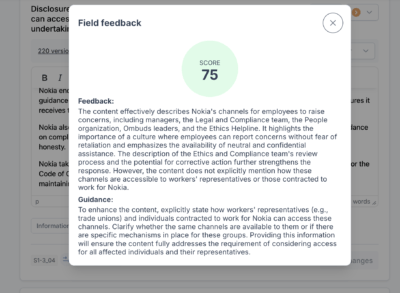
Once figures are automatically entered or imported into the platform, Planmark’s Smart Validation acts as a first-line auditor. It scans your data in real-time to identify inconsistencies, flagging unit errors or values that deviate from historical trends. This proactive scrubbing ensures your team spent their time reviewing high-quality data rather than fixing simple entry mistakes.
AI-Powered “Data Explorer”
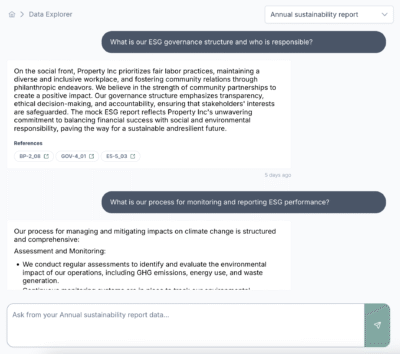
The centerpiece of Planmark’s automation is the Data Explorer. Rather than digging through files to answer a specific question, you can simply query your centralized data in plain language (e.g., “What is our company’s current approach to managing environmental risks in the supply chain?”). The AI interprets your entered data and generates audit-ready, precise responses for tenders, investor inquiries, or global audits.
Automated Disclosure Assistance
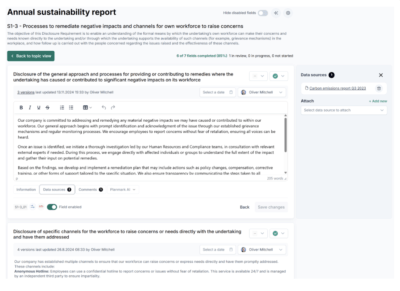
Bridging the gap between “raw numbers” and “professional reporting” is often a manual, weeks-long writing exercise. Planmark’s AI automates this by drafting qualitative narratives based on your entered data, allowing you to refine pre-filled text rather than starting from a blank page. Beyond standard compliance, the platform generates tailored reports for various stakeholders—such as investor decks or internal board updates—and includes automated language translation. This ensures your sustainability performance is communicated clearly across global business units and diverse audit requirements without extra administrative overhead.
3. The “Stop-the-Clock” Dividend
In early 2026 the EU adopted the “Stop-the-Clock” directive, delaying the mandatory reporting start date for many “Wave 2” companies to 2027.
This is the perfect window to implement AI data management systems.
Companies that use this time to implement AI infrastructure will enter the 2027 reporting cycle with a “push-button” capability. Those who continue with manual processes will face the same disadvantages, just two years later.
Built-in Audit Governance
Planmark directly addresses the cost and complexity of external assurance by maintaining a transparent digital “audit trail”. Every figure is linked to its source with full version history, allowing auditors to verify your data in a fraction of the time, which significantly lowers your annual assurance fees.
Strategic Reuse of Data
Rather than treating 2027 as a “compliance deadline,” early adopters use Planmark’s Data Explorer to turn entered data into a reusable asset. You can immediately query your knowledge base to generate instant, validated responses for investor inquiries, tenders, and internal audits during the bridge year.
Mastering Complex Hierarchies Early
Use this window to move beyond “Excel fatigue” and standardize data collection across all subsidiaries and business units. Planmark’s decentralized ownership model allows each entity to manage its own data while you maintain centralized, audit-ready oversight at the group level.
Start your next reporting cycle the right way — try Planmark today.